

Expert Review Blurb: This technical guide was prepared for HVAC contractors and facility maintenance managers using established dual-fuel system design and commissioning practices, manufacturer documentation, and guidance from ComEd’s contractor controls guide. Always verify model-specific procedures, wiring, clearances, ratings, and control sequences before work begins.
As heating season starts in late October, customers are asking whether a heat pump and gas furnace can work together, and whether the combination can lower operating costs without sacrificing comfort. The answer depends on design choices made before the equipment is installed: a well-sized pairing, a deliberately selected changeover point, compatible controls, and startup checks that prove the sequence works.
Use these five steps as a bid-to-commission decision path. Equipment details and thermostat wiring vary, so follow the manuals for the exact models on the job.
1. PICK THE PAIRING
Start with the building load, not the equipment already in the quote. Use a load calculation to establish the design heating requirement, then compare it with the heat pump’s available heating capacity at relevant outdoor temperatures and the furnace’s rated output.
The heat pump should carry as much of the seasonal load as makes sense for the climate, utility rates, and customer priorities. The furnace covers the colder conditions or the point at which another heat source is more practical. Avoid sizing the gas stage simply to match the heat pump’s nominal tonnage: an oversized furnace can bring short cycles, uneven temperatures, and unnecessary cost.
For an 80% AFUE furnace, remember that input BTU is not delivered heat. A 60,000 BTU/h input furnace at 80% AFUE has approximately 48,000 BTU/h output, subject to the model’s ratings and installation conditions. Confirm that its output suits the building load and that its airflow and temperature rise are within the manufacturer’s limits.
Next, decide whether the project uses a compatible furnace-and-coil configuration or another manufacturer-approved indoor arrangement. Verify the outdoor unit, indoor coil, metering device, airflow, refrigerant compatibility, and approved system match. Do not assume two products work together just because their nominal tonnage appears similar. Confirm the match using manufacturer documentation and, where applicable, AHRI certification. For light refrigerant background, see CedarsHVAC’s R-454B refrigerant guide.
2. SET THE BALANCE POINT
The balance point is a control decision, not a universal outdoor temperature.
First find the capacity balance point: the outdoor temperature at which the heat pump’s available heating capacity can no longer meet the building load. Use the load calculation and the heat pump’s published performance data. Then consider the economic balance point, where the cost of heat from the heat pump and gas furnace is approximately equal. That comparison depends on electricity and gas rates, heat pump efficiency at the relevant temperature, furnace AFUE, and local billing details.
These points do not always line up. The heat pump may be able to heat the building below the economically preferred crossover, or the gas furnace may be needed sooner to meet load. Comfort preferences can also influence the setting; some occupants prefer the warmer supply-air feel of the furnace when it is cold outside.
Document the assumptions in the bid and explain that utility rates and occupant preferences affect operating costs. Avoid promising a specific bill reduction based on equipment ratings alone. Revisit the setting after the first heating season using customer feedback and actual operating experience.
3. STAGE THE THERMOSTAT
The thermostat has to tell the system which heat source to use, and prevent incompatible calls. Confirm that it supports the intended heat pump and gas-furnace sequence, including the necessary heat stages, outdoor-temperature logic, and any manufacturer-required dual-fuel control.
A typical conventional setup may involve terminals for 24-volt power, common, compressor, indoor fan, reversing valve, and furnace heat calls. But terminal labels, staging behavior, and reversing-valve operation vary. Never wire by color alone. Follow the heat pump, furnace, thermostat, and any approved dual-fuel control diagrams together.
Outdoor temperature sensing may be built into the control or provided by an external sensor. Verify what the selected thermostat actually supports. Do not assume a thermostat can perform outdoor-temperature changeover merely because it supports heat-pump heating.
The PRO1 T721 is listed for heat-pump or multi-stage applications with 2H/1C capability. Before specifying it for a dual-fuel job, confirm the required furnace staging, sensor and lockout features, and wiring sequence against the product documentation and equipment manuals.
4. CONFIGURE THE CONTROLS
Program the chosen changeover and compressor lockout temperatures according to the design. In a typical dual-fuel sequence, the heat pump serves the load above the selected crossover and the furnace takes over below it. The actual logic can differ by equipment and control strategy.
Check these items before leaving the configuration screen:
- Compressor lockout: At what outdoor temperature should the heat pump stop operating?
- Furnace lockout: Is there a temperature above which the gas furnace is inhibited?
- Changeover behavior: Does the control switch sources cleanly, or can it call both?
- Defrost sequence: Does the furnace temper air during defrost, and is that sequence approved?
- Sensor response: Is the outdoor sensor positioned, wired, and reading plausibly?
Defrost deserves a specific check. A heat pump may temporarily change operating mode to clear frost from the outdoor coil. The event can bring a change in sound, visible steam, or a brief supply-air temperature change. Depending on the equipment, the furnace may or may not operate during defrost. Verify the intended behavior in the manufacturer’s instructions and confirm that furnace and compressor calls do not conflict.
5. COMMISSION, THEN SET EXPECTATIONS
Commission the complete sequence, not just the individual appliances. Confirm airflow and furnace temperature rise against nameplate requirements, verify gas and combustion performance using approved procedures, and check the heat pump’s operation using the manufacturer’s commissioning method.
Then test the control logic under the conditions available on site or through approved test procedures:
- Call for heat with the heat pump enabled and confirm the correct heating mode and indoor airflow.
- Verify any second-stage heat call and confirm the intended heat source responds.
- Simulate the relevant outdoor sensor or lockout condition according to the control manual.
- Confirm the furnace takes over when the programmed sequence requires it and that simultaneous operation is prevented unless specifically permitted.
- Check defrost operation and the return to normal heating using the manufacturer’s approved procedure.
Record the settings and readings, including the changeover temperature, airflow, furnace temperature rise, sensor behavior, and any applicable electrical or combustion measurements. For a furnace pre-season refresher, use CedarsHVAC’s gas furnace tune-up checklist.
Before the first cold snap, tell the homeowner or facility contact what to expect: the heat pump may run for long periods, the system may switch to gas on colder days, and a defrost event can briefly change sound or delivered-air temperature. Explain that energy bills depend on weather, utility rates, building load, thermostat settings, and system performance, not a single efficiency number.
FOUR PRODUCTS TO CONSIDER
These listings illustrate equipment and controls relevant to system planning. They are not, by themselves, a certified matched dual-fuel package. Confirm compatibility and the complete system configuration before ordering.
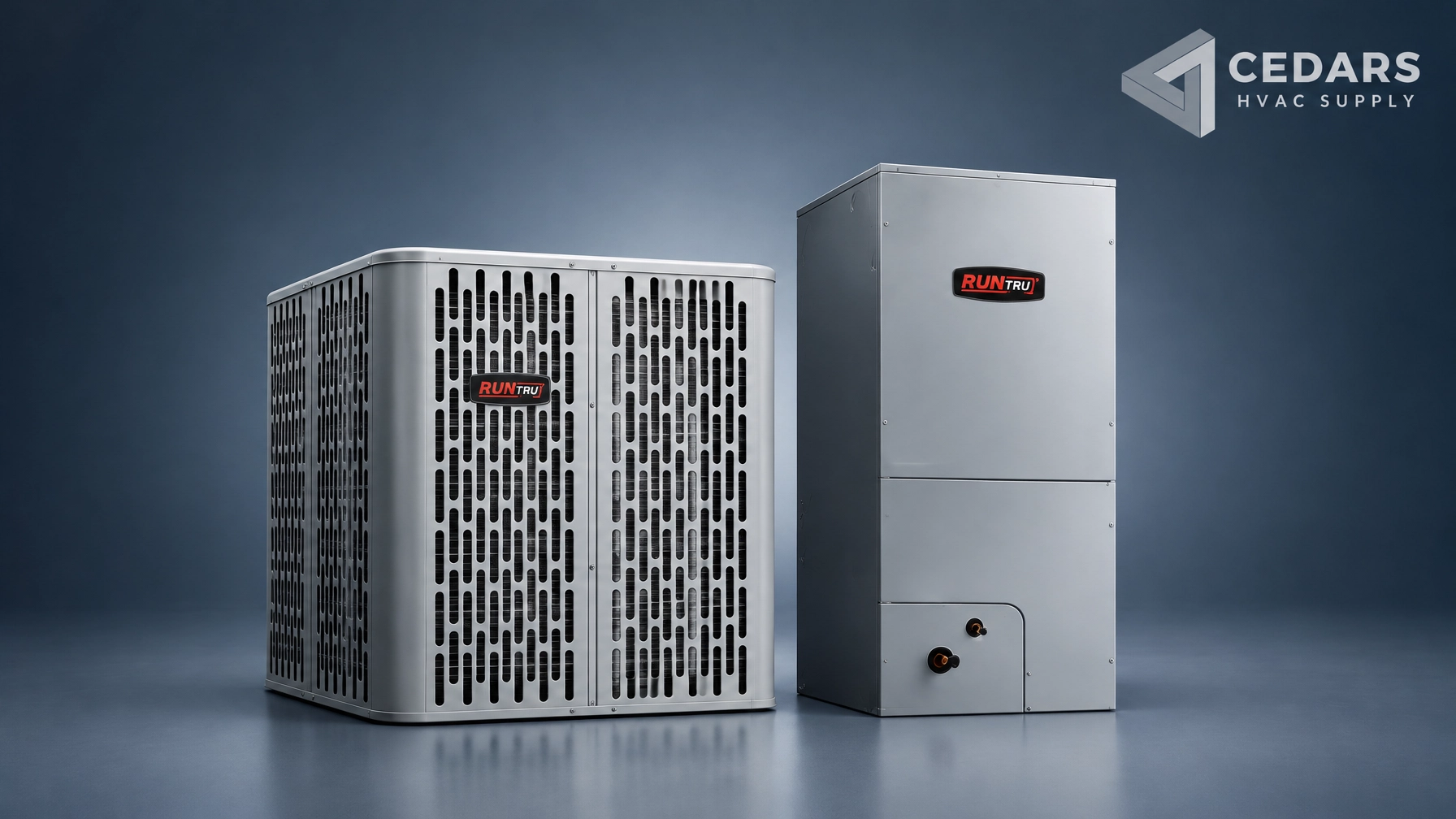
1. RunTru by Trane Furnace and AC System: 2.5 Ton, 60,000 BTU, 80% AFUE
A budget-conscious, multi-positional equipment option featuring a 60,000 BTU input furnace. For a hybrid application, verify the furnace’s compatibility with the selected heat pump and indoor coil; the listed AC system does not itself establish a heat-pump match.

- 🔥 Furnace input: 60,000 BTU/h
- ♨️ Efficiency: 80% AFUE
- 🧭 Configuration: Multi-positional
- 🌬️ Furnace output: Approximately 48,000 BTU/h at rated AFUE
- 💲 Price: $3,398
View the RunTru furnace and AC system
2. RunTru by Trane Ducted Heat Pump: 3 Ton, 36,000 BTU
A same-brand heat-pump option to evaluate alongside a compatible furnace and indoor coil. Check the full model matchup, heating capacity data, and controls before treating it as a dual-fuel pairing.

- ❄️ Nominal capacity: 3 ton / 36,000 BTU
- ⚡ Efficiency rating: 15.2 SEER
- 🔌 Electrical: 208–230 V
- 🧰 System type: Ducted central split heat pump
- 💲 Price: $3,613
3. MRCOOL Central Ducted Hyper Heat System: 5 Ton
For a project where the customer prefers cold-weather heat-pump capacity rather than a gas stage, this complete heat-pump system is an alternative to evaluate against the building load and local conditions. It is not a gas furnace system.

- 🌡️ Rated cooling capacity: 54,000 BTU/h
- 🥶 Heating operation: Listed down to -5°F
- 🔄 Compressor: DC inverter, variable speed
- 🧩 Included: Matched condenser and multi-position air handler
- 💲 Price: $4,346
View the MRCOOL Hyper Heat system
4. PRO1 T721 Multi-Stage Thermostat: Heat Pump (2H/1C)
A control option to evaluate for heat-pump staging. Confirm that its features and wiring support the specific dual-fuel lockout and changeover sequence required for the job.

- 🎛️ Application: Heat pump or multi-stage heating/cooling
- 🔥 Stages: 2H/1C for heat pump applications
- 🔌 Power: Battery or 24 V
- 🧱 Mounting: Wall or junction box
- 💲 Price: $74
A BETTER START TO HEATING SEASON
Good dual-fuel work is a sequence of sound decisions: size to the load, set the changeover intentionally, select controls that support the sequence, and prove operation before handoff. That is Operational Excellence, and part of the Differentiated Experience CedarsHVAC.com is Committed to providing. Our customer-centric approach combines product knowledge, trusted equipment, secure ordering, and reliable shipping for a more delightful experience.
SHOP NOW for the equipment and controls that fit your project. GET STARTED TODAY by reviewing the product specifications and confirming compatibility for the complete system.
E-E-A-T Trust Signal: CedarsHVAC.com serves professional HVAC contractors, refrigeration technicians, facility maintenance managers, and homeowners with industry-focused equipment knowledge and access to established HVAC/R brands. Product fitment should always be confirmed against the manufacturer’s documentation and the equipment model and serial number.
Professional Disclaimer: This guide is provided for general educational and planning purposes. Gas-fired equipment, combustion systems, electrical circuits, venting, heat exchangers, gas pressures, and safety controls should be inspected, tested, adjusted, or repaired only by qualified personnel in accordance with manufacturer instructions, applicable building and fuel-gas codes, and local regulations. Do not bypass safety controls or operate equipment suspected of leaking gas or carbon monoxide. CedarsHVAC.com does not guarantee that the procedures described are suitable for every installation and is not responsible for injury, property damage, equipment damage, code violations, or service outcomes arising from reliance on this content. When in doubt, shut down the equipment and contact a licensed HVAC professional.