
Expert Review Blurb: This technical guide was prepared using CedarsHVAC.com’s commercial refrigeration product knowledge and reviewed against manufacturer-oriented maintenance guidance for low-ambient operation, defrost systems, refrigerant circuits, and compressor protection. It is intended for qualified HVAC/R contractors, refrigeration technicians, and facility maintenance professionals. Always confirm fitment, settings, and installation procedures against the equipment manufacturer’s documentation.
Cold weather changes more than the temperature outside. It changes refrigeration load profiles, condensing pressure, defrost demand, door performance, and refrigerant behavior. A walk-in cooler, reach-in, prep table, or supermarket case that ran reliably through summer can develop frost, drain, control, or oil-return problems within the first sustained freeze.
The most effective winter strategy is simple: inspect the system early and stock the commercial refrigeration parts most likely to be needed before emergency conditions develop.
At CedarsHVAC.com, our customer-centric approach combines trusted brands, technical product knowledge, and reliable shipping to support contractors and facility teams. That is Operational Excellence in practice, and part of the Differentiated Experience our customers expect.
WHY WINTER PREP MATTERS
Lower outdoor temperatures can pull condensing pressure below the range required for stable expansion-valve operation. At the same time, changes in occupancy, door openings, product loading, and humidity can shift the evaporator’s frost and defrost requirements.
Common cold-weather failure symptoms include:
- Ice covering evaporator coils or fan guards
- Frost forming around door frames and gaskets
- Frozen drain lines and drain pans
- Low-pressure cycling or nuisance lockouts
- Poor liquid feed in low ambient
- Refrigerant migration during extended off cycles
- Oil dilution or foaming at compressor startup
- Open display cases struggling to hold temperature overnight
A documented pre-winter inspection creates a baseline for pressures, temperatures, superheat, subcooling, box temperature, amperage, oil level, and defrost performance. It also gives your team time to source the correct HVAC replacement parts before a cold-weather service call becomes urgent.
THE PRE-WINTER INSPECTION CHECKLIST
1. VERIFY DEFROST PERFORMANCE
Test every defrost timer or electronic controller. Confirm the system initiates defrost at the intended frequency and that termination occurs through the correct temperature, pressure, or time-based method.
Inspect:
- Defrost heaters and wiring
- Termination sensors and thermostats
- Timers, relays, and contact points
- Fan-delay controls
- Defrost drain flow
- Alarm and monitoring outputs
Do not simply increase defrost frequency without checking the equipment design. Excessive defrost can waste energy, raise product temperature, and create unnecessary thermal stress. The correct schedule depends on box temperature, humidity, infiltration, product load, and manufacturer specifications.
2. CLEAR ICE FROM COILS, DRAINS, AND DOOR FRAMES
Clean evaporator coils and verify that airflow is unobstructed. Ice buildup reduces heat transfer and can cause fans to contact frost or operate outside their intended conditions.
Flush drain pans and lines. Confirm proper pitch, traps, insulation, and discharge routing. Exterior drain runs and exposed traps may require properly rated heat cable or other approved freeze protection. Follow the evaporator manufacturer’s instructions and local code rather than relying on a universal wattage or temperature setting.
Inspect door frames, thresholds, strip curtains, and pressure-relief ports. Frost at the frame is often an infiltration problem, not simply a defrost problem.
3. CHECK DOOR GASKETS AND HARDWARE
Cold temperatures can harden or distort worn gaskets. A small air leak introduces moisture, increases frost formation, and forces longer refrigeration cycles.
Check:
- Gasket flexibility and compression
- Hinges, closers, latches, and handles
- Door alignment and swing
- Strip curtains and overlap
- Wall penetrations and vapor seals
- Door-frame heaters, where installed
Replace damaged hardware before it becomes a repeated service issue. A properly sealing door is one of the most cost-effective commercial refrigeration parts in the system.
4. CONFIRM LOW-AMBIENT CONDENSER OPERATION
A clean condenser is not enough when outdoor temperatures fall. Verify the installed head-pressure strategy, including condenser-fan cycling, variable-speed control, pressure-regulating valves, sensors, receivers, and low-pressure-start logic.
Low ambient can reduce condensing pressure enough to cause:
- Poor expansion-valve feed
- Flash gas in the liquid line
- Low-pressure trips
- Unstable box temperature
- Difficult starts after an off cycle
Record actual operating conditions and compare them with the OEM commissioning data. Do not change cut-in, cut-out, or fan-control settings simply because winter has arrived.
Also remove leaves, snow, and debris around the condenser. Never cover an energized outdoor condensing unit with a tarp or solid night cover. Restricted airflow can create high head pressure and equipment damage. Engineered wind protection must preserve the manufacturer’s required clearances.
5. CHECK REFRIGERANT CHARGE AND FILTER DRIERS
On split refrigeration systems, evaluate charge using the correct combination of operating pressure, superheat, subcooling, sight-glass condition, and system temperature. Cold ambient changes pressure readings, so charging by pressure alone is unreliable.
Inspect for leaks at:
- Brazed joints
- Service valves
- Vibration points
- Thermally stressed connections
- Evaporator and condenser coil circuits
Replace suction or liquid-line filter driers when the circuit has been opened, after a burnout or major repair, or when moisture, acid, debris, or excessive pressure drop is present. A filter drier should be correctly sized, installed in the proper flow direction, and followed by an evacuation and performance check.
6. PROTECT THE COMPRESSOR AND OIL CIRCUIT
Confirm that the crankcase heater is properly installed, energized during the off cycle, and controlled as intended. During long shutdowns, refrigerant can migrate to the coldest part of the system and dilute compressor oil. A cold-weather restart can then produce oil foaming, poor lubrication, or mechanical stress.
Where the manufacturer requires it, allow the crankcase heater to operate for the specified pre-start period after an extended shutdown. Never bypass the manufacturer’s instructions or energize a heater that is incorrectly sized for the compressor.
Also inspect oil-level controls, oil separators, receiver insulation, and piping supports. Verify that suction-line insulation is intact and that piping has proper slope and support for oil return.
7. CALIBRATE CONTROLS AND SENSORS
Check box sensors, evaporator probes, pressure transducers, thermostats, alarms, and remote monitoring points. Compare displayed temperature with a calibrated reference instrument.
Review:
- Setpoints and differentials
- Defrost termination temperature
- Low-pressure time delays
- Fan-delay settings
- Door alarms
- High- and low-temperature alarms
- Data-logging trends
A sensor that is only a few degrees out of calibration can cause unnecessary defrost, product-quality concerns, or repeated nuisance alarms.
STOCK BEFORE THE FIRST FREEZE
A practical winter stock list should include correctly sized:
- Defrost timers and termination controls
- Drain-line heater cable and approved accessories
- Suction and liquid-line filter driers
- Crankcase heaters
- Pressure controls and sensors
- Door gaskets, latches, hinges, and closers
- Fuses, relays, terminals, and control wiring
- Refrigerant-compatible service fittings
- Open-case night covers
Match every item to the equipment model, voltage, refrigerant, connection size, pressure range, and application. Maintain a record of frequently used parts across each customer account.
FOUR COMMERCIAL REFRIGERATION PARTS TO CONSIDER
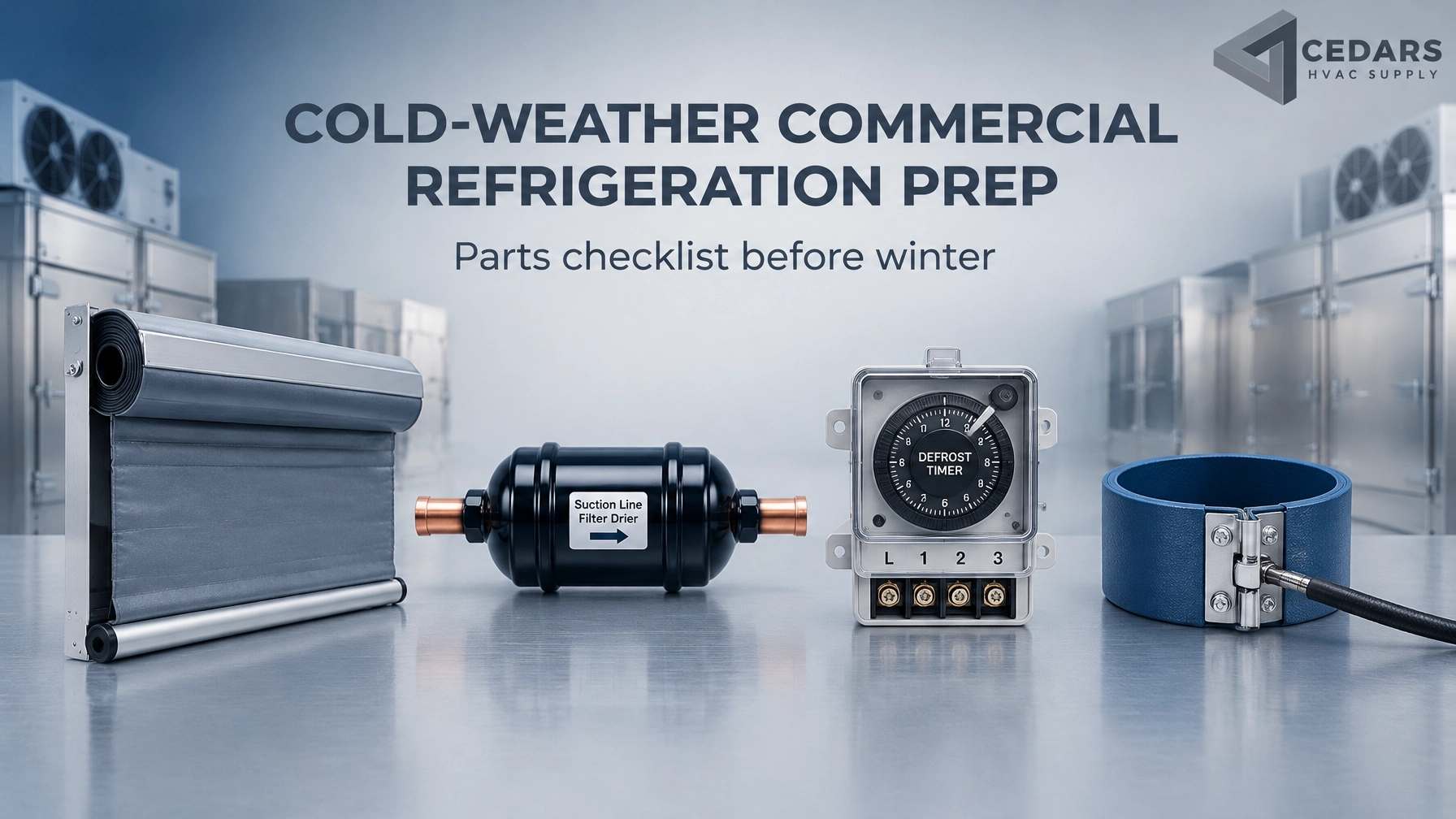
The following four products are listed in the Cedars HVAC catalog and address specific winter-preparation needs. Confirm compatibility before ordering.
QE QCP-1.5 Night Cover PVC Curtain

For open grocery and supermarket display cases, a night cover helps reduce overnight infiltration and retain cabinet temperature when customer traffic and store activity decline.
View the QE QCP-1.5 night cover
- 📏 Size: 48 inches wide × 59 inches long
- 🧊 Application: Open grocery coolers and refrigerators
- 🔄 Operation: Pull-down and roll-up curtain
- 🧰 Included: Mounting brackets, handles, hook, and screws
- 🛡️ Benefit: Helps preserve display temperature during off-hours
Everwell SSFD-286T Suction-Line Filter Drier

This suction-line filter drier is suited to service work where debris, moisture, or contaminants must be controlled after a system opening or major repair.
View the Everwell SSFD-286T filter drier
- 🔩 Connection: 3/4-inch ODF solder
- 🧪 Application: Suction-line filtration
- 🚪 Access: Dual access valves
- 📉 Design: Low pressure drop
- 📈 Maximum working pressure: 600 PSI / 4,140 kPa
- ❄️ Listed refrigerant compatibility: R-410A, R-22, R-134a, and R-407A
Paragon 8145-20 Commercial Defrost Timer

A mechanical defrost timer can support commercial freezer and refrigerator applications using electric heat, hot gas, or compressor shutdown defrost strategies.
View the Paragon 8145-20 defrost timer
- ⚡ Electrical rating: 208–240 VAC, 50/60 Hz
- 🔌 Switch rating: 40 amps, 2 HP, 690 VA
- ⏱️ Backup termination range: 4–110 minutes
- 🧭 Adjustment increments: 2 minutes
- 🔥 Applications: Electric heat, hot gas, or compressor shutdown
- 🧰 Enclosure: Heavy-duty steel with knockouts
Danfoss 120Z0459 PTC Crankcase Heater

This heater is designed to help protect compressor oil during off-cycle refrigerant migration conditions. Correct compressor fitment and installation are essential.
View the Danfoss 120Z0459 crankcase heater
- 🔥 Type: PTC crankcase heater
- ⚡ Power: 27 watts
- 🔌 Voltage: 230–600 V
- 🏷️ Part number: 120Z0459
- 🛠️ Application: Compressor crankcase protection
- ✅ Action: Verify compressor compatibility before installation
FINAL FUNCTIONAL TEST
After inspection and repairs, run the equipment through a complete refrigeration cycle and a complete defrost cycle. Confirm drain flow, heater operation, fan delay, control response, box temperature, and alarm reporting.
Trend the system again during the first cold snap. Seasonal preparation is not a one-time event; it is a controlled transition into a different operating environment.
CedarsHVAC.com is committed to helping professionals source trusted HVAC replacement parts with a Secure, customer-centric buying experience. We provide nationwide shipping, 30-day returns, contractor pricing, and technical support through customer support. Browse the complete commercial HVAC/R catalog or request contractor pricing.
SHOP NOW. GET STARTED TODAY.
SOURCES AND FURTHER READING
- Refrigeration Technologies: Preparing Commercial Refrigeration for Fall and Winter
- Copeland Outdoor Refrigeration Unit Manual
- Heatcraft technical documentation
PROFESSIONAL DISCLAIMER
This article is provided for general educational and informational purposes only. It does not replace the equipment manufacturer’s installation manual, service literature, wiring diagrams, refrigerant requirements, local building and electrical codes, or the judgment of a qualified HVAC/R professional.
Refrigerant recovery, evacuation, charging, brazing, electrical testing, control adjustment, and component replacement should be performed only by properly trained and legally authorized personnel. Product specifications, availability, pricing, compatibility, and shipping information may change without notice. Always verify model numbers, electrical ratings, refrigerant compatibility, pressure ratings, and installation requirements before ordering or installing any part. CedarsHVAC.com makes no guarantee that the procedures or products described will resolve a particular equipment problem and is not responsible for damage, injury, food loss, or code violations resulting from improper diagnosis, installation, or use.