

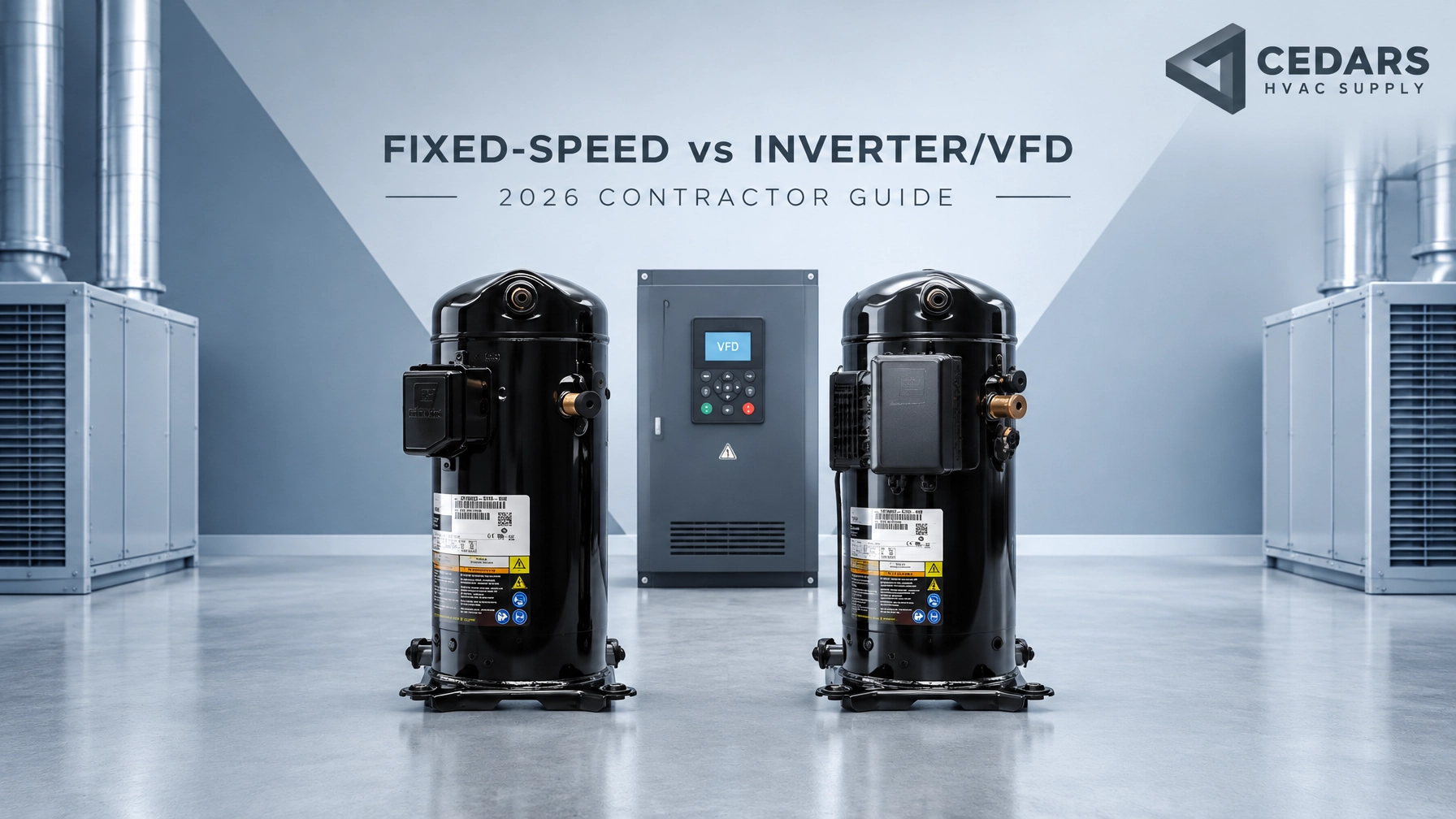
Expert Review Blurb: Reviewed for technical accuracy by the Cedars HVAC technical content team, drawing on practical HVAC/R equipment knowledge, manufacturer specifications, and current 2026 refrigerant and efficiency guidance. This guide is intended for professional HVAC contractors, refrigeration technicians, and facility maintenance managers evaluating compressor replacement and control strategies.
THE SHORT ANSWER
No. Fixed-speed compressors are not dead in 2026.
They are still installed every day in budget-conscious replacements, commercial refrigeration equipment, light commercial rooftop units, and systems where simplicity, serviceability, and equipment compatibility matter more than maximum part-load efficiency.
However, inverter-driven compressors and properly engineered VFD control panels are winning more projects where equipment operates for long hours, loads vary significantly, humidity control matters, or utility incentives improve the payback.
The practical answer is not “fixed-speed or inverter.” It is: match the compressor and control architecture to the load profile, application, budget, refrigerant, and service environment.
WHAT CHANGED IN 2026?
Two changes are shaping compressor decisions.
1. A2L refrigerants are now central to new-system planning
The EPA’s AIM Act Technology Transitions rules are moving much of the residential and light-commercial market away from higher-GWP refrigerants such as R-410A and toward lower-GWP A2L refrigerants, including R-454B and R-32.
A2L refrigerants are mildly flammable and require equipment, tools, installation practices, and safety controls designed for that refrigerant classification. Contractors must follow the equipment listing, manufacturer instructions, local mechanical codes, and applicable EPA requirements.
Existing R-410A systems can generally still be serviced. The transition does not mean that every operating R-410A system must be replaced immediately. But new equipment selection in 2026 requires careful verification of refrigerant compliance, manufacture dates, sell-through rules, and local enforcement.
Review the ICC overview of EPA’s A2L transition and current NAHB guidance on the EPA’s R-410A rule.
2. Efficiency compliance still matters
The refrigerant transition does not replace DOE efficiency requirements. New equipment must still meet the applicable SEER2, EER2, HSPF2, IEER, or other efficiency requirements for its equipment class and region.
A fixed-speed compressor can be part of a compliant system. But system efficiency depends on more than compressor type. Coil design, airflow, fan power, controls, refrigerant charge, staging, and operating conditions all affect real-world performance.
Contractor rule: confirm both requirements before quoting:
- Refrigerant and A2L compliance
- Applicable DOE efficiency rating and AHRI match
WHEN FIXED-SPEED STILL MAKES SENSE
BUDGET REPLACEMENTS
For a customer facing an unexpected compressor failure, a fixed-speed replacement may provide the fastest and most economical path back to operation.
If the existing system uses a compatible fixed-speed compressor, replacing it with the correct capacity, voltage, phase, refrigerant, and motor configuration can reduce labor and commissioning complexity. This is especially relevant when the system has limited remaining life or the owner plans a complete replacement later.
The lowest purchase price is not always the lowest installed cost. A compatible fixed-speed unit can reduce:
- Control modifications
- Wiring changes
- Commissioning time
- Technician training requirements
- Spare-parts complexity
COMMERCIAL REFRIGERATION
Walk-in coolers, reach-in cases, prep tables, and fractional refrigeration systems often have relatively stable operating requirements. A fixed-speed hermetic compressor remains practical when the equipment cycles predictably and the control system is designed for on/off operation.
For these applications, reliability, availability, and straightforward service can outweigh the energy savings of variable-speed operation.
LIGHT COMMERCIAL RTUs
Small rooftop units serving offices, retail spaces, and storage areas may operate with relatively simple schedules and moderate load variation. A fixed-speed compressor can still be a sensible choice when:
- The building has limited operating hours
- The load is consistent
- The owner prioritizes low first cost
- Existing controls are difficult to upgrade
- Utility rebates are unavailable
- The unit is a direct replacement
Fixed-speed equipment also remains familiar to many service teams. That matters when a facility has limited controls expertise or needs broad technician coverage.
WHERE INVERTER OR VFD CONTROL WINS
PART-LOAD EFFICIENCY
Most HVAC systems do not operate at design load all day. Inverter compressors can modulate capacity to track the actual load instead of repeatedly cycling between full output and off.
That can reduce cycling losses, improve temperature stability, and lower average energy use. The benefit is usually greatest in buildings with long run hours and changing occupancy or outdoor conditions.
HUMIDITY CONTROL
In humid climates, a system that runs longer at reduced capacity can provide more consistent moisture removal than a large fixed-speed system that satisfies the thermostat quickly and shuts off.
This can improve occupant comfort and reduce complaints about clammy spaces, especially in:
- Retail stores
- Medical offices
- Restaurants
- Schools
- Coastal facilities
- High-occupancy residential buildings
LOW-AMBIENT OPERATION
Variable-speed compressor and condenser fan control can improve low-ambient performance when properly engineered. Instead of relying only on aggressive cycling, the system can maintain more stable condensing conditions.
That can benefit refrigeration systems, process cooling, and facilities that need reliable operation during shoulder seasons or cold outdoor conditions.
UTILITY REBATES AND DEMAND MANAGEMENT
Some utilities offer incentives for high-efficiency equipment, variable-speed drives, demand reduction, or controls upgrades. These incentives can materially change the replacement decision.
Do not assume a rebate applies. Confirm the required efficiency rating, eligible equipment category, pre-approval rules, commissioning documentation, and installation deadline before presenting the savings estimate.
THE RETROFIT MATH CONTRACTORS SHOULD RUN
A useful comparison starts with measured or defensible operating assumptions.
Basic annual energy calculation
Annual energy use = average operating kW × annual operating hours
Then estimate:
Annual energy savings = (old average kW − new average kW) × annual hours × electricity rate
For facilities with demand charges, include the estimated reduction in peak kW. Also include:
- Equipment and control-panel cost
- Installation labor
- Electrical modifications
- Commissioning and controls integration
- A2L tooling or training requirements
- Expected maintenance cost
- Utility rebates
- Downtime exposure
- Replacement-part availability
For example, if a variable-speed retrofit reduces average compressor and fan demand by 3 kW over 4,000 annual operating hours at $0.15 per kWh:
3 kW × 4,000 hours × $0.15 = $1,800 estimated annual energy savings
That is only an illustration. Contractors should use trend data, utility bills, run-time logs, nameplate information, and manufacturer performance tables whenever possible.
A retrofit may be justified by energy savings, improved humidity control, reduced demand charges, or longer equipment life: not energy savings alone.
HOW VFD CONTROL PANELS PROTECT EQUIPMENT
A properly specified VFD control panel can help reduce mechanical and electrical stress on compatible compressor and fan motor applications.
Benefits may include:
- Controlled acceleration instead of an abrupt full-voltage start
- Lower starting current and reduced voltage disturbance
- Less belt, shaft, coupling, and bearing shock on fan systems
- Improved condenser fan speed control
- More stable suction and discharge conditions
- Fault monitoring and protective shutdowns
- Adjustable minimum and maximum operating speeds
But a VFD is not automatically compatible with every compressor. Before installation, verify motor type, drive compatibility, oil-return requirements, minimum speed, maximum speed, motor cooling, harmonics, electromagnetic interference, bypass strategy, and manufacturer approval.
For hermetic compressors, use an approved inverter-duty or variable-speed compressor and matching controls. Do not attach a generic drive to a fixed-speed compressor without documented engineering approval.
FOUR FRESH HVAC/R PRODUCTS TO CONSIDER
The following products are distinct replacement and system-support options from the Cedars HVAC catalog. Always verify model, refrigerant, voltage, phase, capacity, mounting, and application before ordering.
1. Carrier P032-4021 3.5-Ton Reciprocating Compressor

A practical fixed-speed replacement candidate for compatible air-conditioning applications and legacy equipment.
- ⚙️ Capacity: 3.5 ton / 41,000 BTU
- 🔌 Voltage: 208–230 V
- 🔢 Phase: 1 phase
- 🧊 Refrigerant listing: R22 and R407C
- 🛠️ Motor configuration: Permanent split capacitor
- 🧾 Manufacturer part: P032-4021
2. Bautzen QD35H 1/8 HP Fractional Refrigeration Compressor

This compact hermetic piston compressor is suited to compatible refrigerator, freezer, commercial refrigeration, and dehumidification applications.
- ⚙️ Motor rating: 1/8 HP
- 🔌 Voltage: 110–120 V
- ⏱️ Frequency: 60 Hz
- 🧊 Refrigerant: R134a
- ❄️ Application range: Low, medium, and high backpressure applications
- 🔇 Design benefits: Low noise, low vibration, and compact footprint
3. QE QCA-402 2-Pole 40-Amp Definite-Purpose Contactor

A replacement switching component for compatible HVAC/R compressor and motor circuits.
- ⚡ Poles: 2
- 🔌 Coil voltage: 24 V
- 🧰 Rating: 40 A
- ⏱️ Frequency: 50/60 Hz
- ✅ Listing: UL registration identified by the manufacturer
- 🔩 Construction: Panel-mount design with quick-connect terminals
4. Carrier HD60FE656 3.7 HP Blower Motor

This industrial blower motor is intended for compatible Carrier air-moving equipment and selected rooftop applications.
- ⚙️ Horsepower: 3.7 HP
- 🔌 Voltage: 208–230/460 V
- 🔢 Phase: 3 phase
- ⏱️ Frequency: 60 Hz
- 🔄 Speed: 1,750 RPM
- 🏢 Application: Compatible Carrier air-moving equipment, including selected 581JE units
THE 2026 DECISION CHECKLIST
Before choosing fixed-speed or inverter/VFD-driven equipment, document:
- Load profile: steady, seasonal, or highly variable?
- Run time: short schedule or continuous operation?
- Humidity requirements: is moisture control a performance priority?
- Refrigerant: legacy service replacement or new A2L system?
- Electrical service: can the facility support the required controls and power quality?
- Compatibility: are the compressor, motor, drive, controls, and oil-return strategy approved together?
- Rebates: are incentives confirmed in writing?
- Service capacity: can the maintenance team troubleshoot and stock the new technology?
- Payback: does the full installed cost justify the projected savings?
- Future planning: is this a repair, a bridge solution, or a long-term asset decision?
THE BOTTOM LINE
Fixed-speed compressors remain a valid professional choice in 2026. They are often the right answer for direct replacements, commercial refrigeration, light commercial RTUs, and projects where budget and service simplicity lead the decision.
Inverter compressors and VFD control panels are stronger choices when the system has substantial part-load operation, humidity-control needs, low-ambient requirements, long run hours, or confirmed utility support.
The winning approach is customer-centric and data-driven: select the architecture that delivers dependable capacity, compliant refrigerant operation, maintainable controls, and a measurable return.
Cedars HVAC is Committed to Operational Excellence and a Differentiated Experience for contractors and facility teams sourcing HVAC compressors, VFD control panels, and HVAC replacement parts. TRUST the specifications, verify compatibility, keep the installation Secure, and GET STARTED TODAY with a documented equipment comparison.
Sources and Further Reading
- Cedars HVAC compressor catalog
- Cedars HVAC motors catalog
- Cedars HVAC contactors catalog
- Cedars HVAC shop
- Nu-Calgon NuStart product information
- Cedars HVAC returns policy
Professional Disclaimer: This article provides general educational information and is not a substitute for the equipment manufacturer’s installation instructions, engineering review, applicable EPA requirements, local building and mechanical codes, electrical code, or professional legal advice. Product specifications, inventory status, pricing, refrigerant requirements, rebates, and regulatory interpretations may change. Verify all model numbers, electrical ratings, refrigerant compatibility, AHRI data, A2L requirements, and site conditions before purchase or installation. Installation, refrigerant recovery, charging, electrical work, and control integration should be performed by appropriately licensed and trained professionals.